The world of medicine is like a bubble. A lot of people THINK they know what goes on there, but unless you're down in the trenches it's unlikely you do. So here is my semi-anonymous blog, here to tell you what really goes on in the life of a medical resident.

Wednesday, June 28, 2006

Things I would like to get off my chest...

In honour of my last day of my internal medicine rotation, I would like to air some grievances. So here, in brief, are a few things that I've wanted to say at some point during the past two months.

To the nurse who paged me at 3:30 in the morning, 10 minutes after I had managed to drag myself to my call room for the first time that night-- you seriously called me to clarify a TYLENOL order from someone I'd just admitted from emerg? Are they in dire need of Tylenol RIGHT NOW? No? Then leave me alone.

To the woman who gives out the call room keys at the information desk of the hospital-- I am aware that it is 4:45pm. I am also aware that we aren't supposed to pick up call room keys until 5pm. But this might be the only chance I get to get down to the information desk before the keys become fair game to other services at 1am. So unclench and give me a freaking key.

To the patient who told me that the reason she was feeling better was because my attending was such a good doctor and that she really respected and valued his medical skill. My attending couldn't pick you out of a lineup. I am your doctor, for all intents and purposes. I am the one who has visited you daily, managed your care, fought on your behalf for tests and spent time looking up information on alternative treatment options. He visits you for about 10 seconds every second day or so. Not that I'm looking for a medal here, but seriously!

For the rookie nurse that just started on the floor-- I don't envy your position. You must feel overwhelmed. But if you call me in the middle of the night wanting something ordered, please at LEAST know what the person was admitted for, what other meds they're on and what allergies they have. When I have to sit there holding the phone while you say "um, I'm not sure" and look through the patient's chart, I am not amused.

To my senior, who knows a helluva lot of internal medicine and very little about people-- that's really something you need to work on. Yelling at a patient's family member because she doesn't understand the difference between "intubation" and "resuscitation" when clarifying code status will not win you Humanitarian of the Year awards.

To the infection control people, whomever you are-- my patient has been in the hospital for three days with a COPD exacerbation. I have no idea what posessed you to decide that he needed to be in isolation with droplet precautions AFTER we discharged him home (for the 15 minutes he was waiting for a cab) but that may win the prize for the most ridiculous hospital policy ever.

To my attending-- don't manage my patients behind my back. Particularly not if you're going to decide, with the help of the urology attending, what the right treatment is for my patient when you've never taken the time to actually meet her. If you'd spoken to me, you'd know that putting a percutaneous nephrostomy tube in a developmentally delayed woman who yanks out lines as fast as we can place them is a recipe for disaster.

To the entire Interventional Radiology department-- what the hell makes you so special? Why can you get away with not answering phones, not returning calls and not answering pages? Why do we need to actually go down to IVR and seek you out in person and beg you to perform procedures on our patients, like you're doing us a big, fat, favour? IT'S YOUR FREAKING JOB!

To the nurse on 4Z who paged me 4 times in an hour because I hadn't come to pronounce her patient yet-- as I've told you three times already, I am dealing with someone crashing on the floor. Your patient is unlikely to get any deader. The one I am treating right now is a very different story. So no, pronouncing your patient is not my priority right now.

To the chief medical resident who made up the call schedule for the month of June-- was scheduling me for 4 call in 8 days a punishment for taking vacation at the beginning of the month? Or are you just trying to kill me? And I know that someone has to be on call on the last day of the rotation... but why does it always seem to be me?

Sigh. I feel better now.

Labels: ,

Monday, June 26, 2006

Stick a Fork in Me...

It's funny. I used to think that the worst month to get get sick would be July. All of the new residents start on July 1st. But now, nearing the end of my first year of residency (or the end of my internship, for all you Americans out there) I no longer think that July is the scariest month to be in hospital... it's June.

In July, we KNOW we're new. We're scared. We feel like we've suddenly been given a massive amount of responsibility that we may or may not deserve. And for the love of God-- we don't want to screw it up. So we're meticulous. And careful. And probably more than a little paranoid. So the first few times the nurse calls for an order in the middle of the night, we'll drag our asses out to the floor to review the patient's chart first. And we'll double-check the dosage. And triple-check the med list and the allergies. And THEN we'll write the order. If a nurse calls and wakes me up because a patient is hypotensive, I'm on my way to assess them before she's hung up the phone. And it's not just the R1's that are like this-- as the R1's in internal medicine take up the lofty title of Senior Medical Resident, literally overnight they are ultimately responsible for the CCU, two wards of inpatient medicine, all consults from emerg, all consults from other services and every code called in the hospital. It's a lot. And rightfully, they're petrified as July 1st draws nearer.

But what a difference a year makes.

Want an order? Are they allergic? Any obvious contraindications? No? Sure, give them Ativan 0.5 mg po qhs prn. I barely even have to wake up anymore. Your patient is hypotensive-- are they stable? Any congestive heart failure? Give them a bolus of fluid and take the pressure again once it's run in. If it's still low, call me back. If a patient is stable I probably won't get out of bed for a systolic less than 85. Apathy? Maybe a little. But I can now do the bread and butter of my job with my eyes closed-- and sometimes, at 4:30am, I do.

Labels: ,

Saturday, June 17, 2006

The Streak is Dead... Literally

Considering the amount of time I've spent in the Emergency Room, people are often amazed when I tell them I've never had a patient die. Honest. Actually, my life has been pretty much untouched by death entirely (touch wood, quick!). All of my family members who have passed away did so when I was too young to really get it, and no one has died in the past 15 years or so. Colour me lucky. And my patients... well, I guess they've been lucky too. I've had a patient or two die, but it was never while they were actually under my care. And only one of them was a patient that I'd actually had time to get to know beyond last name and chief complaint.

Even when people are supposed to die on my watch, they manage to hang in there until a new team comes on in the morning. A patient can be actively trying to die throughout the day but will miraculously stabilize at the exact moment I accept the code pager. And speaking of codes-- four code blues, four ICU transfers, three have improved well enough to come back to the floor. One is still in ICU, but doing better. No deaths. Un-freaking-believeable.

Basically, if you have a parent in the hospital... you want me on call. Not for my skills, but for my crazy good karma.

Now in all fairness, this might also be due to the fact that since becoming a resident I have actually spent very little time in the company of sick patients. Anaesthesia, Emergency Psych and Obstetrics don't often lose patients. And my time in family medicine was much the same. So the only time I was ever really in danger of losing a patient was during my hellish two months of general surgery and now, in my second month of internal medicine.

Which is why I was a little unprepared when I got called in the middle of the night to pronounce a patient on the hematology/oncology ward. We don't usually cover that ward on internal medicine-- those patients have specialized problems, and are usually handled by the specialists themselves. This was a young-ish guy (in his late 40's) who had developed a particularly unfortunate case of Graft-Versus-Host-Disease after a bone marrow transplant for a rare lymphoma. He had been doing poorly in hospital for over a month, and had acutely decompensated over the past few days. His death was expected to the extent that the attending hematologist had already gotten verbal consent from the man's wife for an autopsy to try to explain his recent rapid decline. All I had to do was pronounce the man dead and fill out the death certificate.

I knew the drill. I had seen it once as a medical student, and I knew the steps in theory. I entered the patient's darkened room and offered my condolences to the family. I then asked them to step out of the room for a moment while I examined their loved one. I turned my attention to the recently deceased. His mouth was fixed open in a silent scream, his head tilted towards the ceiling. Thankfully, his eyes were closed. His hands were cold and doughy. I was hesitant to touch them, feeling as though I were intruding on him at his most vulnerable. I felt for a pulse. Carefully, I peeled back his hospital gown to place my stethescope on his chest. I listened to the silence for a full two minutes, spurred by the irrational fear that if I rushed the process the poor man would sit bolt upright on the pathologist's steel table and I'd be interviewed on the evening news. I heard nothing. No breath sounds, no heart sounds. I tapped on the diaphragm of the stethescope to make sure it was working. It was. He wasn't. I pressed into his nailbed to assess response to pain. I reached over to rub his sternum but stopped-- his skin looked so fragile and delicate that I worried it would tear under my knuckles. Instead, I skipped to the last step. Prying open his dry eyes, I carefully touched a cotton swab to his cornea. No reaction. I gently drew his eyelid shut again.

I left the room. After a few more (likely contrived and artifical) words to the family, I retreated to the paperwork that accompanies death. I pondered over the offical cause of death for what was probably longer than I needed to. The autopsy would provide that information anyway... whatever I wrote would just be a guess. All I could think of was the coroner's talk we had received at the start of residency.

"Cardiorespiratory arrest is NOT the cause of death. Cardiorespiratory arrest IS death."

But I couldn't think of anything else to write.

By the time my shift ended at noon, I had been called to pronounce a second patient. An elderly man on the internal medicine ward with metastatic cancer, who had been bouncing in and out of the emergency room with severe nausea, vomiting and dehydration but determined to live out as much of his remaining days in the comfort of his home. Finally, he gave in and came into hospital to stay. He died with his family at his bedside, a jaundiced figure with a belly bloated with ascites and extremities that had wasted away to skeletal proportions. Although he wasn't 'my' patient at the time of his death, he had been under my care the week before during one of his shorter admissions. I knew him.

I don't know how many people I will have to pronounce during my medical career. I'd rather not speculate. But in the middle of the night in the darkened ward I laid to rest my first patient. And although I've already forgotten his name, his face will stay with me much longer.

Labels: ,

Friday, June 02, 2006

You HAVE to be kidding me.

Yet another reason to hate call.

I don't have allergies. At least, I've never had any allergies that I am aware of. But I am seemingly allergic to call. Back at medical school, when a night of call was quiet enough that I slept for a period of time in my call room I would often wake up frequently during the night completely congested. I'd wake up in the morning rubbing my sticky eyes, trying to breathe out of my stuffed nose and prone to sneezing fits. Fun stuff.

Then I change cities. And hospitals. But the allergies remain. Now I've never had this reaction to another room away from home-- I've stayed in countless hotels and hostels and I've never had the same reaction to them as I do to call rooms. Dust? Could be, but my home can get pretty dusty too. Bleach? Don't think so. The call rooms are so sterile that I can't think of much that they all have in common-- plastic coated pillows that crinkle every time you move, rough white sheets, institutional blankets that need to be layered in factors of ten before they actually provide any warmth... what else is there?

Eventually, I just accepted that I am allergic to call and sucked it up.

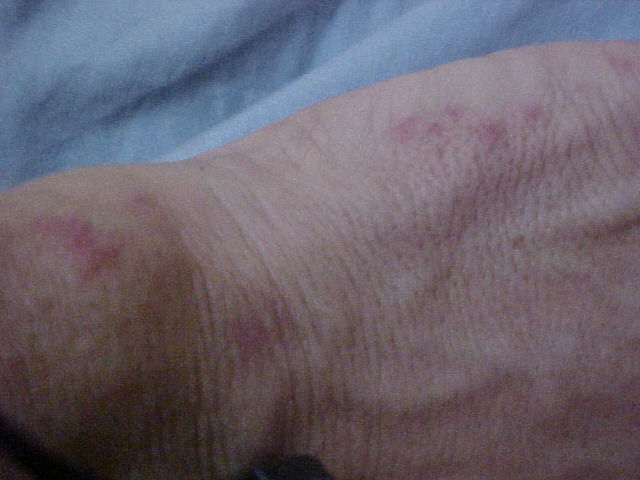
Recently, though, it got worse. I started waking up from call ("waking up" is a bit of an exaggeration since I rarely get more than 20 consecutive minutes of sleep) with a rash. Again, I wasn't too concerned. I have insanely sensitive skin that is still recovering from a bout of poison ivy passed to me from the puppy from hell after a morning walk in the woods, and I seem to get random hives on a regular basis.

But these weren't hives. They looked like little pimples. And they itched like the dickens. I had a batch of them on my right ankle, and another batch on my left forearm. Then I looked closer-- the ones on my forearm formed a perfect line.


Ugh. I have bedbugs. Or rather, the call rooms have bedbugs. I am so grossed out right now I can't even think. The idea of bugs crawling over me as I sleep... UGH! If I can get bed bug bites when I sleep fully clothed, I don't want to think of what I'm taking home from the hospital attached to me in some way.

Labels: , ,

Tuesday, May 30, 2006

Medical Urban Legends

As medical students, we whispered about it. Residency. We had read the books: The House of God, which chronicled one young intern's loss of everything that made him human as residency beat him down. The Intern Blues and Rotations, two books that followed peds residents through their first year of internship. We knew that they had no life outside of the hospital and that on the odd time they TRIED to socialize they would commit some horrible social blunder like falling asleep at a family wedding. We knew that would soon be us. We knew that clerkship was no measure of what residency would be like. As clerks, we got called to do consults in emerg... but when issues arose on the floor, the nurses would page the people whose signature meant something... the residents. So we would often get to sleep, at least for a few hours. We knew it would get worse.

But even though we had begun mentally preparing ourselves for the stresses of residency, there were still the whispered rumours that circulated among the medical students. One surgery program in the province was allegedly known for its 100% divorce rate among it's residents. Another was notorious for putting their residents on 1 in 2 call... and submitting dummy call schedules to the union so as not to get reprimanded. We knew the stories. They were repeated time and time again as a warning not to enjoy life too much-- if would soon get pulled out from under us.

There was one story, though, that made even the most naive medical student raise an incredulous eyebrow.

"Didja hear? An ortho resident at Big Name University Hospital had a STEMI."

"Yeah?"

"He was 31."

"No."

"Dude. Swear to God. I heard it from my senior, whose staff works with the nurse who knows the guy's clerk. He almost died. Stress. Lifestyle. It's crazy."

"Heh. Does ortho let you leave at noon post-call if you have a STEMI?"

"Doubtful."

Ortho is the ironman of residency programs. Only for the hardest of the hard-core. Big men (for the most part) wielding saws, hammers and drills in the OR. Long hours, long patient lists... short marriages, and apparently, according to recent lore, short lives. An ortho resident (as is the case with most residents) simply cannot maintain a healthy lifestyle. The work week lasts 120 hours. Call is 1 in 3, and is usually without sleep. Rounds start at 6am so that they're done in time for the OR at 8am. The OR ends at 6pm, when it's back to the ward to deal with the scut. Then, if you're one of the few lucky enough to be going home that day, you're out by 8pm. Usually. Exercise? Please. Eating right? Eating at all is an impressive feat, and it's usually cafeteria fare shoved unceremoniously down the orthopod's throat while the OR is being turned over between patients. Downtime? Stress relief? You've got to be kidding me.

I was a disbeliever. I thought that residency was only as bad as you make it. I brushed aside tales such as that of the 31-year-old orthopod with the STEMI as urban legend, passed on to strike fear in the hearts of medical students everywhere.

Fast forward to the present day.

I'm sitting at the nursing station on the internal medicine floor writing in a chart. Sitting next to me is a fellow junior resident, whom I'll call Steve in a half-hearted attempt at anonymity. Steve was post-call, and was dressed in the shapeless green pyjamas that residents have been trying to pass of as real clothes since the dawn of medicine. This is significant because scrubs have short sleeves. Usually, on internal medicine, guys wear dress shirts. Long sleeves. While chatting with Steve, I happen to glance down at his exposed forearm. A prominant scar marked his inner arm, extending from his elbow to his wrist. Steve caught me staring.

"Impressive, eh?"

"Bar fight?" I asked, jokingly.

"CABG."

"Pardon you?"

"Yeah. I had a STEMI in my second year of residency." He said it nonchalantly, as though he told the story on a daily basis.

"Oh! I thought you were first year internal." Obviously, I was at a loss as to the appropriate response when someone catches you staring at their deeply scarred forearm. Because what year his was in was OBVIOUSLY the important thing, here. Sigh.

"I am. But I used to be ortho. I had the STEMI in my second year, when I was 31. I had to take a leave of absence, and I transferred to internal medicine. I probably wouldn't have survived ortho if I'd gone back to it."

"Um, wow."

Less-than-brilliant response aside, I am now a believer.


P.S. A STEMI, by the way, is an ST-elevation myocardial infarction. For the purposes of this story just think of it as a VERY bad heart attack. CABG is a coronary artery bypass graft (pronounced "cabbage").

Labels: ,

Monday, May 22, 2006

A Comedy of Errors...

...only none of them were funny. I was on Friday-Sunday call this weekend. So I went into the hospital on Friday morning, didn't leave until Saturday noon, went back on Sunday morning and didn't leave until Monday noon. Not the nicest way to spend my long weekend, but at least I get a "lieu" day for working on the stat holiday.

Last night was busy for internal medicine. We got flooded with referrals from emerg, nearly all of which required admission into hospital. There were many of the usual suspects-- MI's, COPD exacerbations, CHF exacerbations, and the parade of confused eldery people usually found to be suffering from pneumonia or urosepsis. There were a few more interesting cases, too-- and a few that should have been routine but became more interested through gross mismanagement.

In our hospital it's not unusual for patients to spend a day or more in the emergency room after being "admitted" (on paper, anyway) waiting for a bed. The emergency room is a busy place, and it isn't the nicest place to be hanging around all night. Plus, the nurses are busy and the care that our patients get isn't the same as if they were on the floor. Usually, this is just inconvenient. This night, however, it became downright ridiculous.

At around 11pm I saw an 18-year-old kid with diabetic ketoacidosis. This is a serious complication of (usually) Type I diabetes that has a 5% fatality rate. So it's taken pretty seriously. I had actually asked to see this referral as I had never managed a DKA before and wanted the experience. I had admit orders (instructions to the nurses on how to manage the patient) within 30 minutes of seeing him. They included close monitoring, an insulin drip, correction of his hypokalemia (low blood potassium, can cause heart arrhythmias if not treated), blood sugars measured every hour, electrolytes measured every two hours... the usual. By 5am, not only had the orders not been implemented, but the night nurse had allowed the patient to take his usual dose of long-acting insulin. You don't have to necessarily understand the medical management of acid-base disorders to appreciate the bottom line-- this delay in treatment could have killed this kid. Luckily, he wasn't all that acidotic (it's the acidosis that kills, not the blood sugar per se) and was fine the next morning. But things could have easily turned out much worse.

One of the other residents saw a young (early 40's) healthy guy who had a spell of atrial fibrillation (a heart arrhythmia) after finishing a 5k run that afternoon. First of all, it didn't need to be referred to internal medicine-- he was stable, and could have easily been started on medication and followed up as an outpatient. But he got referred, so we saw him. The other resident ordered some anti-arrhythmic medications and decided to keep him overnight on telemetry (constant vital sign monitoring). Good thing. Her orders weren't carried out either-- he never got his meds, and ended up going into atrial flutter (a worse arrthymia) in the middle of the night.

At midnight, already snowed by admissions and referrals (including a very rare blood disease, the management of which was a mystery to everyone including the thrombo attending on call) the R5 (emergency medicine resident in his fifth and final year of residency training) dumped three referrals on us that hadn't even been worked up. His explanation?

"Well, they're three old ladies that are confused and short of breath, so whatever the cause they'll end up going to your service anyway."

Um, thanks. This is the kind of bullshit that gives emergency medicine a bad name with other services. I took one of them-- an 88-year-old woman with severe Alzheimer's dementia who was non-verbal. All I knew was that the nursing home had thought her to have a decreased level of consciousness that afternoon and sent her in by ambulance. The resident hadn't even ordered a CBC (the most basic of blood tests).

To add to the confusion, the computer system went down inexplicably sometime after 1am. So we had no access to lab values, x-rays... and perhaps most importantly when dealing with demented elderly patients who can't tell you about their medical history, their old notes and files. Information was passed by phone calls from the lab and the stressed radiology resident, and was then relayed through a twisted game of broken telephone until it reached us and could be translated into a diagnosis and treatment plan. In many cases, it was easier to give up on nailing a diagnosis and just start everyone with nonspecific fever on broad-spectrum antibiotics and delay the more formal workup until the morning.

I guess that night was the perfect storm of problems-- some of them, like the computer problems, being nobody's fault. Others, like the mass referral of patients without workup, the resident's fault. But the delay in receiving treatment that some of our patients experienced last night was downright dangerous. If it had been my family member, you can be damn sure I'd be demanding answers. Not enough nurses? Not enough beds on the floor? Complete incompetence of the health care team in general? Maybe a little of each. But it's definitely not a night I'd like to repeat.

But maybe I'm naive in thinking that this was an unusual scenario.

Labels:

Friday, May 12, 2006

Back on Call


And believe it or not, I'm not complaining about it. Why would I? After my first week of internal medicine, I've come to realize that when I'm on call is the only time I'm going to get a chance to do any real medicine. Sigh.

Honest, I'm not complaining. Thankfully, it looks like my experience in Internal Medicine is gearing up to be WAY better as a resident than it was as a medical student. For starters, I'm now working in a centre with much less of an emphasis on "shame-based learning" as we affectionately refer to the art of pimping. People seem more interested in making sure you learn something than they are in publicly humiliating you for what you don't already know. Second, my team rocks. I have an attending who is so nice that she often has trouble convincing people that she's an internist. My senior is very non-initmidating, reasonable and approachable. I haven't met the other junior yet... she's on vacation this week. But so far, so good...

The teaching on this service is amazing. We get a minimum of two one-hour teaching sessions a day. Very different from family medicine, where I got... well, none. So far I've learned about aortic stenosis, aortic sclerosis, toxic epidermal necrolysis, nonspecific elevations in liver enzymes, what those clotting tests we order ACTUALLY measure, atrial fibrillation, asthma, rheumatoid arthritis and a bunch of other topics that I've probably forgotten already.

But believe it or not, call was good. And not only because I actually got some sleep (although those of you who have been reading my blog since my surgery rotation can understand what a difference an hour or so makes) but because I got to practice medicine. See, internal medicine isn't exactly medicine. Or at least it isn't medicine if you're the JMR (Junior Medical Resident). My days are spent 'managing my patients'. In plain English, this means chasing down lab results, filling out paperwork, attending endless "meetings" to plan discharges for people who are just taking up acute care beds with no acute medical issues.

At night, however, things are different. And not bad different. Rather than being left on my own to sink or swim with dozens of very sick patients with no backup (yes, referring to that damn surgery rotation again), I am part of a team. I have someone to refer to if I feel like I'm in over my head managing the ward. In addition, I get to see the consults to medicine from the emergency room. Some interesting stuff comes through there. My night on call saw two acute coronary syndromes (one STEMI and one NSTEMI), a post-ictal (after a complex partial seizure), a superior vena cava syndrome from a huge goiter, a new-onset SVT in a cancer patient, a COPD exacerbation and a rule-out Guillain-Barre. Pretty interesting stuff.

Internal medicine call. Interesting. I must be losing my mind.

Bring on the codes.

Labels: ,