The world of medicine is like a bubble. A lot of people THINK they know what goes on there, but unless you're down in the trenches it's unlikely you do. So here is my semi-anonymous blog, here to tell you what really goes on in the life of a medical resident.

Friday, June 02, 2006

You HAVE to be kidding me.

Yet another reason to hate call.

I don't have allergies. At least, I've never had any allergies that I am aware of. But I am seemingly allergic to call. Back at medical school, when a night of call was quiet enough that I slept for a period of time in my call room I would often wake up frequently during the night completely congested. I'd wake up in the morning rubbing my sticky eyes, trying to breathe out of my stuffed nose and prone to sneezing fits. Fun stuff.

Then I change cities. And hospitals. But the allergies remain. Now I've never had this reaction to another room away from home-- I've stayed in countless hotels and hostels and I've never had the same reaction to them as I do to call rooms. Dust? Could be, but my home can get pretty dusty too. Bleach? Don't think so. The call rooms are so sterile that I can't think of much that they all have in common-- plastic coated pillows that crinkle every time you move, rough white sheets, institutional blankets that need to be layered in factors of ten before they actually provide any warmth... what else is there?

Eventually, I just accepted that I am allergic to call and sucked it up.

Recently, though, it got worse. I started waking up from call ("waking up" is a bit of an exaggeration since I rarely get more than 20 consecutive minutes of sleep) with a rash. Again, I wasn't too concerned. I have insanely sensitive skin that is still recovering from a bout of poison ivy passed to me from the puppy from hell after a morning walk in the woods, and I seem to get random hives on a regular basis.

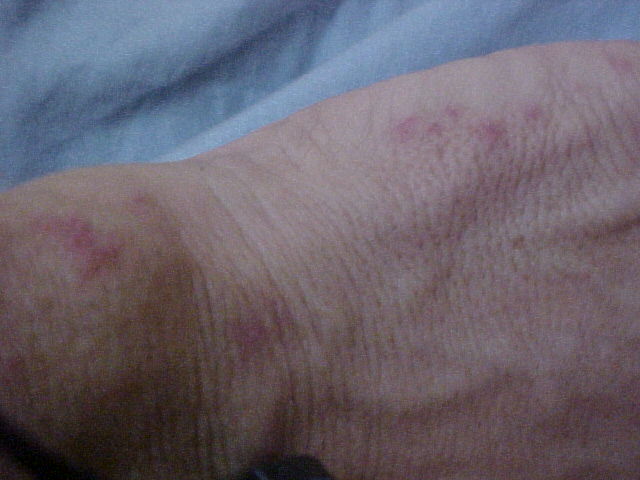
But these weren't hives. They looked like little pimples. And they itched like the dickens. I had a batch of them on my right ankle, and another batch on my left forearm. Then I looked closer-- the ones on my forearm formed a perfect line.


Ugh. I have bedbugs. Or rather, the call rooms have bedbugs. I am so grossed out right now I can't even think. The idea of bugs crawling over me as I sleep... UGH! If I can get bed bug bites when I sleep fully clothed, I don't want to think of what I'm taking home from the hospital attached to me in some way.

Labels: , ,

Friday, May 12, 2006

Back on Call


And believe it or not, I'm not complaining about it. Why would I? After my first week of internal medicine, I've come to realize that when I'm on call is the only time I'm going to get a chance to do any real medicine. Sigh.

Honest, I'm not complaining. Thankfully, it looks like my experience in Internal Medicine is gearing up to be WAY better as a resident than it was as a medical student. For starters, I'm now working in a centre with much less of an emphasis on "shame-based learning" as we affectionately refer to the art of pimping. People seem more interested in making sure you learn something than they are in publicly humiliating you for what you don't already know. Second, my team rocks. I have an attending who is so nice that she often has trouble convincing people that she's an internist. My senior is very non-initmidating, reasonable and approachable. I haven't met the other junior yet... she's on vacation this week. But so far, so good...

The teaching on this service is amazing. We get a minimum of two one-hour teaching sessions a day. Very different from family medicine, where I got... well, none. So far I've learned about aortic stenosis, aortic sclerosis, toxic epidermal necrolysis, nonspecific elevations in liver enzymes, what those clotting tests we order ACTUALLY measure, atrial fibrillation, asthma, rheumatoid arthritis and a bunch of other topics that I've probably forgotten already.

But believe it or not, call was good. And not only because I actually got some sleep (although those of you who have been reading my blog since my surgery rotation can understand what a difference an hour or so makes) but because I got to practice medicine. See, internal medicine isn't exactly medicine. Or at least it isn't medicine if you're the JMR (Junior Medical Resident). My days are spent 'managing my patients'. In plain English, this means chasing down lab results, filling out paperwork, attending endless "meetings" to plan discharges for people who are just taking up acute care beds with no acute medical issues.

At night, however, things are different. And not bad different. Rather than being left on my own to sink or swim with dozens of very sick patients with no backup (yes, referring to that damn surgery rotation again), I am part of a team. I have someone to refer to if I feel like I'm in over my head managing the ward. In addition, I get to see the consults to medicine from the emergency room. Some interesting stuff comes through there. My night on call saw two acute coronary syndromes (one STEMI and one NSTEMI), a post-ictal (after a complex partial seizure), a superior vena cava syndrome from a huge goiter, a new-onset SVT in a cancer patient, a COPD exacerbation and a rule-out Guillain-Barre. Pretty interesting stuff.

Internal medicine call. Interesting. I must be losing my mind.

Bring on the codes.

Labels: ,

Saturday, November 26, 2005

A Post-Call State of Mind

Being post-call is not a fun thing. It's like that point in the evening when the fun buzz of being drunk has worn off and you just feel mildly ill and very tired. It's not fun being at the bar anymore, and all you can think about is crawling into bed.

Depending on how rough the night was and how many hours (or minutes) of sleep you managed to sneak, there are various degrees of post-call. If you've managed to catch a few hours (for me, this is anything more than 4) it's actually not too bad... you're a little tired, and more than a little anxious to see anything outside of the hospital, but fully aware that it could have been much, much worse. For me, this kind of night is often punctuated by interruptions that I have no recollection of in the morning. I find that I've given verbal orders for all sorts of things the next morning. A little disconcerting, for sure, but they were all appropriate. The ones I found out about, anyway.

The next level of post-call hell is when the night was busy, but you managed to get a couple of hours in... often in a contorted position in some random corner of the hospital that is not your call room (whose 4-inch thick matress isn't all that luxurious anyway). In this case you're dragging in the morning, but able to push through until the magical noon hour that (in theory and union contract) marks your release. With the help of copious amounts of coffee, that is.

The deepest state of post-call hell is where I was after Tuesday night. It was bad from the start. I was late for handover because I was draining an abscess off some guys back that was literally 30 cms in diameter... and projected from his back at least 10 cms. The pus that came pouring out of this thing once we hit the right pocket was unbearable. We managed to stink up the entire emergency room. One of the nurses had to leave the room from the stench. Another nurse came back with masks, which helped... a bit. Ugh. So I made it up to the floor by 6:30pm or so, at which time a nurse called me over to mention that his patient had felt a little short of breath while walking in the hall. Not a big deal, except that his O2 sat was 75% at the time. Sigh.

Many investigations and hours later it was determined that this guy had a pulmonary embolus. I wish I could say that I make the diagnosis based on the 'classic signs of right heart strain' on his ECG, but I missed those. I did, however, have the sense to call the SMR (medicine consult from the senior resident on call) when his arterial blood gas (which I got on the first try, thankyouverymuch) showed a pO2 of 50 and a pCO2 of 30. Yikes. For those of you not in medicine... this is VERY VERY bad. Add to the mix a young woman with a post-op ileus (paralyzed bowel) who wouldn't stop thowing up and a woman complaining of pain in her enterocystic fistula (meaning stool was coming out where urine should be) and I didn't sit down until the wee hours. The nurses were great... one of them measured me for TED stockings when I mentioned how much my legs were aching and another scrounged up a half a sandwich for me at 10pm or so. TED stockings, for the uninitiated, are butt-ugly things that help your veins pump blood back up to your heart against gravity. After 24 hours on your feet, the ache is unbelieveable. We put them on people at risk of clots. Lovely, aren't they?

I may have neglected to mention that before this night from hell started, the day was nothing to brag about either. I was also on day call, which just means that whenever there's a consult to be done by surgery they'll page me. I love day call since I'd much rather be in emerg than in the OR. Today, however, we got five consults in the space of an afternoon. One on a 100 and some-year-old man under the care of internal medicine who, I learned later, wasn't expected to live through the day. So why consult surgery, you may ask? Brilliant question. The SMR (acronyms again... Senior Medical Resident) responsible for his care called me later to tell me that she was fully aware that he wasn't a surgical candidate and his family had refused any further intervention, but she was curious if we thought his x-ray showed a small bowel obstruction. You have to be kidding me. YOU TOOK UP 90 MINUTES OF MY TIME DOING A BOGUS CONSULT BECAUSE YOU WERE CURIOUS???? I'm going to end the story there because otherwise there will be violence and coarse language and my mom reads this blog. But as expected, this poor man ended up passing away peacefully that night. Without sugery.

Another consult was in the ICU. The staff there was concerned that this patient's x-rays indicated an obstruction (it was apparently bowel obstruction day). I (and later, my staff) wasn't quite so concerned. The x-rays were borderline, and mostly just suggested the patient was constipated. We suggested trying noninvasive stuff before we suggested surgery. Late that night, which doing another consult in the emergency room, I got another page from the ICU. Apparently they had repeated the patient's abdominal films and found lots of free air under the diaphragm. That's not good. It meant that something had perforated, and this patient needed urgent surgery. So I called the staff member on call and the chief resident, and explained what was going on. I headed to the ICU to get started on the pre-op stuff. Unfortunately, the doors to the ICU slid open to reveal a large crowd outside the patient's door... that's never a good thing. Sure enough, the patient had coded just moments before. The staff surgeon got there just in time to see the ICU doc pronounce our patient dead.

So, no surgery. Still plenty to do, though, since the patients on the floor seemed to be having all sorts of problems needing immediate assessment. By 4:30am I was starting to feel physically ill from the effort it was taking to stay awake. I managed to curl up on the reclining chair in the closet they call the resident's office on the floor... there was no point going down to my callroom when I knew that even if there was nothing else happening on the floor I still had to be up in an hour to look up bloodwork and x-rays before teams started rounding at 6am. I got two 15 minute naps before it was time to get up for good. It was brutal. This kind of post-call is the worst. You feel completely depersonalized. You're nauseous. You are unable to formulate coherent thoughts, let alone express them. At this point, I have to honestly say that I feel like I'm a danger to my patients.

And then we drive home. Scary, isn't it? Studies have shown that the number of medical errors made by interns was much higher at the end of a traditional 30-hour shift than if the shift were limited to 16 hours (New England Journal of Medicine, 2004). Other studies (which I don't remember the citation for) found that the response time (as measured on a driving simulator) of a post-call resident is equivalent to being intoxicated. Yet we think nothing of letting interns and residents drive home after a 30-hour shift. A group of residents had this discussion after one of our seniors confessed to falling asleep at the wheel and ending up in a ditch. One might think that we'd be better at setting boundaries for ourselves... knowing when it wouldn't be safe to get behind the wheel. Then again, people who are injured (or who injure others) while driving drunk have sued the people providing the alcohol, whether it be the bar or the hosts of a party. If we were to do the same, would the hospital be liable?

Hmmm.

Labels: ,

Saturday, November 05, 2005

Things That Go 'Beep' in the Night

My first night of surgery call. I survived it. More importantly, so did every patient under my care. Even the guy on the colorectal team (i.e. under the other surgery team's care and therefore a total stranger to me until something goes wrong and he needs me to know everything about him) who was supposed to die (according to the resident on his team) was considerate enough to keep on trucking until the light of day broke over the many montiors and buzzers that echo through the halls of 4Z in the middle of the night.

It actually wasn't too bad. The time went quickly until I finally dragged myself to my call room at around 2am. Things were steady, but not overwhelming. For my first few calls I have a senior who serves as my back-up. I saw a few consults in emerg, my clerk saw one from another service (and reported it back to me... I could get used to this 'delegating responsibility' thing) and there was the usual scut from the floor. I don't mind scut. It makes me feel competent.

"What's that nurse? Your patient can't sleep? Well, let me, the incredibly useful and competent intern, give you a verbal order for Ativan 0.5 mg PO qhs prn, thus SAVING THE DAY."

Or not.

But don't think that hitting my military-issue hospital cot at 2am was the end of my night. Oh no. After about 45 minutes of hard-earned sleep, my pager went off. It was the emergency room. Uh-oh. Another consult. But no, it was a nurse asking about a patient who had come to emerg after being discharged by general surgery the week before. This was a 34 year old guy who had apparently, for reasons that are still unclear, taken a 30 foot swan dive from a building resulting in some nasty internal injuries. Apparently, she had been collecting a stool sample from this guy only to find that instead of stool, his bowels had produced a thick, mucous-like substance that was yellowish green in colour. She wanted to let me know.

"Um, thanks."

"Well," asked the nurse impatiently, "what is it?"

I decided to be honest. "I have no idea."

"Is it normal?"

"Beats me."

"What should I do about it?"

I paused. It was just before 3am, and I was in no mood to play 'guess the bodily fluid' with this nurse.

"Look, is he being referred to us? Is he direct to general surgery? Are we responsible for him in any way?"

The nurse admitted sheepishly that we were not.

"Then I really can't help you."

I am not in the mood for pleasentries at 3am.

About 20 minutes later I ended up down in emerg for another consult anyway. While I was down there looking at the notes on the patient, I overheard a nurse on the phone with the orthopedic surgery resident.

"But it doesn't even LOOK like stool, it just looks like mucous. What should I do about it?" She apparently had not given up on her quest to find someone to identify whatever the hell was coming out of this guy's ass. A moment later, she hung up the phone. Another nurse asked her what he had said.

"He said to put it in a sample jar, send it to the lab and leave him the hell alone."

Word.

Labels: , ,